Updated: May 2026
Why Kelimutu's Three Lakes Change Color: The Science (2026)
Two of three lakes shift color on multi-year cycles.
What geochemists have figured out, and what remains genuinely mysterious.
Kelimutu” target=”_blank” rel=”noopener noreferrer”>kelimutu-sunrise-flores-3-day-tour/”>See our 3-day trip →

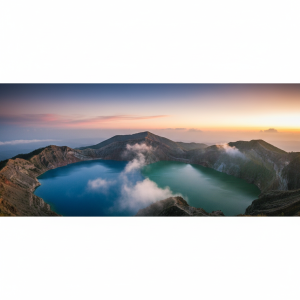
Kelimutu has three crater lakes at its summit, in different volcanic vents that connect underground but vary independently in chemistry. Each lake has a Lio name with mythological meaning, and visitors typically remember their colors more than their names.
The three lakes
Tiwu Ata Polo (“Lake of Bewitched”) — easternmost. Currently dark turquoise to greenish-blue. Historically has shifted from blue to red.
Tiwu Nuwa Muri Koo Fai (“Lake of Young Men and Maidens”) — middle. Currently turquoise. Shifts least dramatically.
Tiwu Ata Mbupu (“Lake of the Old People”) — westernmost. Currently nearly black. Has historically been brown, dark olive, or red.
What controls the color
The water in each lake has different concentrations of dissolved minerals — chloride, sulfate, iron salts, dissolved volcanic gases. These come from active fumarole vents in each crater. The mineral content reacts with light differently:
— Iron-3+ (ferric) salts → red to brown
— Iron-2+ (ferrous) → green to dark olive
— Sulfate-rich, low iron → blue to turquoise
— High dissolved sulfide → black
When volcanic gas composition shifts (typically over 6-18 month cycles), the lake oxygenation changes, and iron flips between Fe(II) and Fe(III), producing color shifts. The two outer lakes (Ata Polo and Ata Mbupu) shift more — they have more direct fumarole input. The middle lake is more buffered and shifts least.
What remains mysterious
Several aspects haven’t been explained satisfactorily:
1. The two outer lakes occasionally shift IN OPPOSITE DIRECTIONS at the same time, despite being only ~300m apart. This implies their underground hydrology is separate, but the geometry isn’t fully mapped.
2. The Lio oral tradition records dramatic color shifts going back at least 7 generations — long before any volcanic monitoring. The tradition is consistent with modern observations.
3. The middle lake (Nuwa Muri) occasionally turns RED briefly — a pattern that doesn’t fit the mineral-shift model. Theories include sudden anaerobic events with bacterial bloom, but no eyewitness has gotten samples in time to test.
Implication for visitors
The lake colors when you arrive may not match the photos online. Most online photos show the lakes at peak color — the rest of the time they’re more muted. Our advice: come for the experience and the geology, not specifically to match a particular photo.
See the lakes for yourself
Our 3-day trip includes geology-aware commentary alongside photography. We bring local Lio elders for the storytelling.
The mystical dawn: experiencing Kelimutu’s sunrise spectacle
Imagine the pre-dawn chill, a velvet cloak of night slowly lifting to reveal a world painted in hues that defy belief. This is the unparalleled drama of a Kelimutu sunrise, an experience that transcends mere sightseeing to become a profound communion with nature’s most enigmatic artistry. Long before the first rays kiss the horizon, discerning travelers begin a gentle ascent to the summit, often accompanied by a private guide who shares whispered tales of the Lio people and the sacred significance of these volcanic wonders. The air, crisp and invigorating at 1,639 meters (5,377 feet) above sea level, carries the promise of an unfolding marvel, setting the stage for one of Indonesia’s most captivating natural phenomena.
As dawn breaks, the sky ignites in a symphony of oranges, pinks, and purples, casting an ethereal glow over Kelimutu’s three distinct crater lakes. It is in this hallowed moment that the lakes, each a unique crucible of mineral-rich water, reveal their true, often startling, palettes. While the scientific explanations for their shifting colors are fascinating, witnessing the lakes transition from shadowy depths to vibrant, living canvases is an entirely sensory event. The silence is profound, broken only by the occasional click of a camera or the soft murmur of awe from fellow travelers, all united in their appreciation of this fleeting, magnificent display. A luxury visit typically includes comfortable transport directly to the trailhead, allowing for a leisurely pace and ample time to absorb the panoramic vistas that stretch across the rugged Flores landscape.
The magic doesn’t dissipate with the full arrival of daylight. Instead, the colors deepen, revealing the subtle nuances that make each lake a geological masterpiece. After the spectacle, a well-appointed breakfast awaits, perhaps a picnic of locally sourced delicacies enjoyed against the backdrop of the now fully illuminated craters. This unhurried approach allows for contemplation and photography, ensuring that every moment of your Kelimutu sunrise experience is savored and etched into memory. It’s an immersion that redefines the concept of a “morning view,” transforming it into a vibrant, living canvas that continues to surprise and inspire.
Beyond the crater: Flores’ enchanting cultural tapestry
While Kelimutu’s lakes are undoubtedly the star attraction, the journey to this geological marvel is equally enriching, weaving through the vibrant cultural mix of Flores island. The Lio people, indigenous to the region surrounding Kelimutu, hold a deep reverence for the lakes, which they believe are the resting places for the souls of the departed. This spiritual connection is palpable, informing their customs, traditional architecture, and daily life. A luxury itinerary often includes visits to authentic Lio villages like Wologai or Saga, where guests can witness traditional weaving, observe intricate ceremonial houses, and perhaps even participate in a coffee-making demonstration, gaining an intimate understanding of a culture deeply intertwined with its volcanic landscape.
The island of Flores itself is a collection of biodiversity and cultural heritage, offering a compelling counterpoint to the dramatic landscapes. From the pristine beaches and coral gardens of the Riung 17 Islands Marine Park to the ancient megalithic sites scattered across the central highlands, the island invites exploration. Culinary experiences on Flores are also a highlight for the discerning palate, featuring fresh seafood, aromatic spices, and unique local delicacies. Imagine savoring a freshly prepared meal at a boutique lodge overlooking verdant rice paddies, the flavors of the island telling their own story. The population of Flores is approximately 2 million, a mosaic of diverse ethnic groups, each contributing to the island’s rich cultural mosaic. To truly appreciate the depth of this heritage, consider including a guided excursion to learn about the history of the Lio people and their ancestral traditions.
Engaging with the local communities offers a unique perspective on sustainable tourism and the preservation of cultural identity. Many luxury travel providers collaborate directly with local artisans and guides, ensuring that your visit contributes positively to the community. This holistic approach allows travelers to not only witness the natural wonders of Kelimutu but also to connect meaningfully with the people and traditions that make Flores so extraordinary. It’s an opportunity to discover the authentic heart of Indonesia, far beyond the well-trodden paths, where every interaction is a step deeper into a living, breathing culture.
Crafting your bespoke Kelimutu journey
Embarking on a luxury journey to Kelimutu begins with seamless logistics, ensuring comfort and efficiency from the moment you arrive in Indonesia. Most international travelers fly into Bali’s Denpasar airport, then connect via a domestic flight to Ende (ENE) or Maumere (MOF) on Flores island. The flight from Bali to Ende typically takes around 1.5 hours, followed by a scenic drive to Moni, the charming village that serves as the gateway to Kelimutu. For the ultimate in convenience, private charter flights can also be arranged, whisking you directly to Flores and minimizing travel time, allowing more moments for immersion and relaxation. The drive from Ende to Moni is approximately 50 kilometers, winding through picturesque rice terraces and traditional villages, a journey in itself.
The ideal time to visit Kelimutu for optimal viewing conditions is during the dry season, which spans from May to September. During these months, the weather is generally clear, offering crisp views of the lakes and remarkable sunrises without the interference of rain or heavy cloud cover. While the lakes can be visited year-round, the dry season ensures a more reliable and comfortable experience. Luxury accommodations in Moni, though limited, offer boutique charm and personalized service, providing a tranquil base for your explorations. Some bespoke itineraries might even include glamping experiences closer to the national park, blending wilderness adventure with refined comfort.
A truly bespoke Kelimutu journey extends beyond just the sunrise. It often includes curated experiences such as guided hikes through coffee plantations, visits to hot springs, or even a serene sunset session overlooking the Flores Sea. Expert local guides, fluent in English and deeply knowledgeable about the region’s geology, culture, and flora and fauna, are indispensable. They not only navigate the terrain but also enrich your understanding of this unique destination, transforming a simple trip into an memorable expedition. For more inspiration on exploring this captivating island, consider consulting resources like Indonesia.travel’s guide to Flores, ensuring your journey is as rich and rewarding as the destination itself.